QRX: scan → action
Quick response experience.
You just scanned a normal QR code. The QRX Scanner opened qrx.dev, discovered a QRX flow from the page, and that flow pointed to this HTML experience.
Same QR. Smarter experience.
How QRX works
Easy.
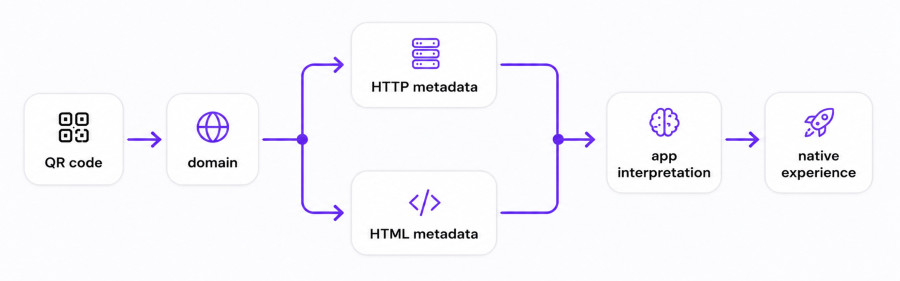
A QRX-compatible app receives a link, fetches the destination, reads the metadata it understands, and launches a native action or experience around that information.
The app can discover information from multiple layers of the web: HTTP metadata and HTML metadata.
What is QRX?
QRX is a way for apps to understand and interact with links instead of simply opening them in a browser.
A QRX-compatible app can receive a link from a QR code, pasted URL, shared link, browser extension, NFC tag, app share sheet, or any other source.
The app can fetch the destination behind the link, extract machine-readable metadata, and launch a native experience around that information.
In some cases, QRX experiences can also work without internet access: through local formats, embedded metadata, nearby devices, or previously cached information.
The link itself does not change. What changes is how apps interpret the destination behind it.
Why does QRX work?
Because websites can expose machine-readable information through HTTP headers and HTML metadata.
QRX-compatible apps can use that information to understand what a destination represents and decide what should happen next.
A browser usually treats the link as a page. A QRX-compatible app can treat the same link as a flow.
Where can QRX be used?
QRX fits anywhere a QR code or link is already used, but the default browser experience feels too limited.
A venue can use one QR code for tickets, check-in, maps, event schedules, and app-specific actions.
A product package can point to one domain, while different apps discover warranty info, manuals, authenticity checks, support flows, or product registration.
A public place can use one QR code for information, accessibility tools, local services, safety instructions, or app-specific experiences.
When does QRX matter?
QRX matters when a generic browser page becomes an unnecessary middle step.
Modern apps already understand identities, subscriptions, products, locations, tickets, devices, media, and relationships between things.
QRX becomes useful when apps start using web metadata to create direct and contextual experiences instead of simply opening webpages.
Who is QRX for?
QRX is for apps that already know how to handle something better than a browser does.
A browser treats almost every QR code the same: open website.
But many apps understand more than that. They understand feeds, profiles, products, tickets, locations, devices, payments, identity, media, and relationships between things.
QRX is for apps that want to use that understanding after receiving a link.
Implementation
QRX does not require a new QR code format. A normal QR code can still point to a normal domain.
The difference happens after the app receives the link. The app can inspect the destination, read the metadata it supports, and choose the right native experience.
<link rel="alternate"
      type="application/rss+xml"
      href="https://example.com/feed.xml">

<link rel="alternate"
      type="application/atom+xml"
      href="https://example.com/atom.xml">

<link rel="alternate"
      type="application/feed+json"
      href="https://example.com/feed.json">

<link rel="canonical"
      href="https://example.com/">
JavaScript package
QRX has a JavaScript package for developers who want to add QRX flow discovery to apps, scanners, browser extensions, services, or experiments.
The current package focuses on discovering machine-readable flows from websites through HTML metadata and HTTP Link headers.
Right now, the main focus is feed discovery: RSS, Atom, JSON Feed, and QRX custom flows.
npm install @qrxcode/jsimport { resolveQRX } from "@qrxcode/js";
const result = await resolveQRX("https://example.com");
console.log(result);DirectFlow.App
DirectFlow is an experimental app built around the ideas behind QRX.
Instead of treating websites as pages to manually browse, DirectFlow tries to understand what flows a website exposes.
A user can paste a normal website URL, scan a QR code, or share a link into the app. DirectFlow then discovers machine-readable flows exposed by that destination.
Right now the main focus is feed discovery: RSS, Atom, JSON Feed, and QRX flows.
The goal is to make following websites feel more like following accounts inside modern apps.
QRX does not replace QR codes. It makes apps smarter about the links they already receive.